How to Apply for Tenders in South Africa: A Practical Guide
A practical guide to getting your business ready, finding suitable tenders and preparing a compliant bid response in South Africa.
Published
You've found a tender your business can deliver. Then the pack reveals an unverified bank account, conflicting company details or evidence you don't have. Those gaps can end a bid before price is considered.
Learning how to apply for tenders in South Africa means keeping your records current, choosing opportunities you can qualify for and following each buyer's instructions exactly.
Table of Contents
- Getting Your Business Ready to Bid
- Finding Tenders That Match Your Business
- Deciding Whether to Bid
- Preparing a Compliant Bid Response
- Bidding When You Lack Track Record or Audited Accounts
- Troubleshooting Common Submission Problems
- Building a 90-Day Tender Readiness Cycle
Getting Your Business Ready to Bid
Prepare your records before a closing date forces you to rush. The Central Supplier Database (CSD) became the single source of supplier information for organs of state on 1 April 2016. It consolidates and verifies registration, ownership, banking, tax, identity, state-employment and restriction information, as outlined in the Department of Small Business Development's supplier guidance.
CSD registration signals interest; it doesn't guarantee work. Suppliers register themselves, and government institutions use the information to check supplier details.
Put your records in the right order
Confirm your legal entity first, align its bank and tax records, then register on the CSD. Check the completed profile against your documents: registration alone doesn't mean every detail is verified.
Use this flow to organise preparation, but follow the evidence requirements in each tender.
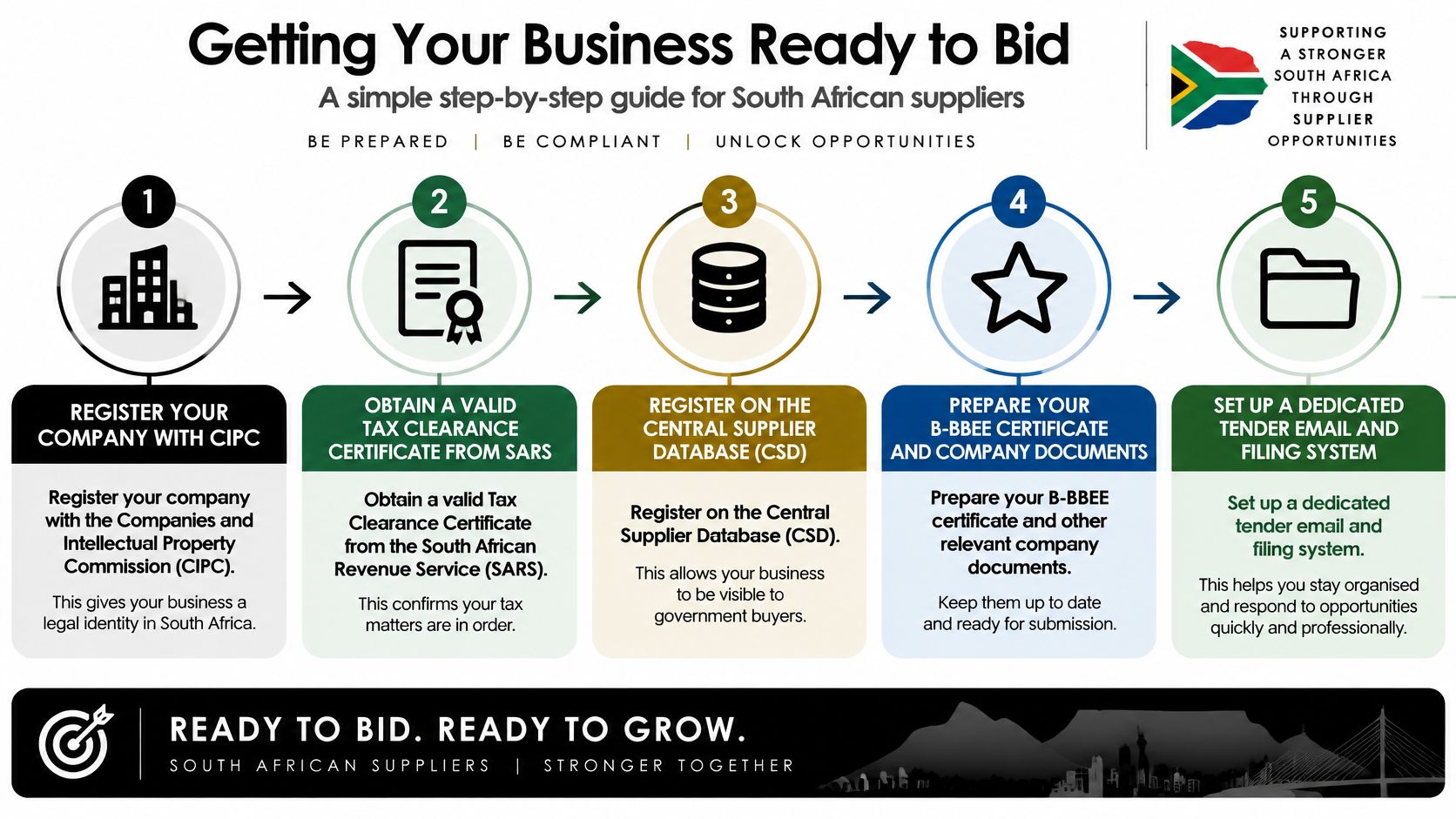
Check your current tax-compliance status, rather than relying on an old certificate. Procuring entities may verify status through the database.
Keep a control sheet for:
- Identity and registration: Match the legal name, registration and ownership details across records.
- Banking: Confirm the account belongs to the bidder and verification is complete.
- Tax and contacts: Check current status and contact details.
- Supporting evidence: Track the location and review date of B-BBEE documents, declarations and other company records.
Maintain the profile after registration
Assign an owner to update changes in directors, banking or contacts, and verify that each update appears wherever those details are used. Review your compliance folder before every bid: a genuine document may still be outdated or inconsistent with the bidding entity.
Finding Tenders That Match Your Business
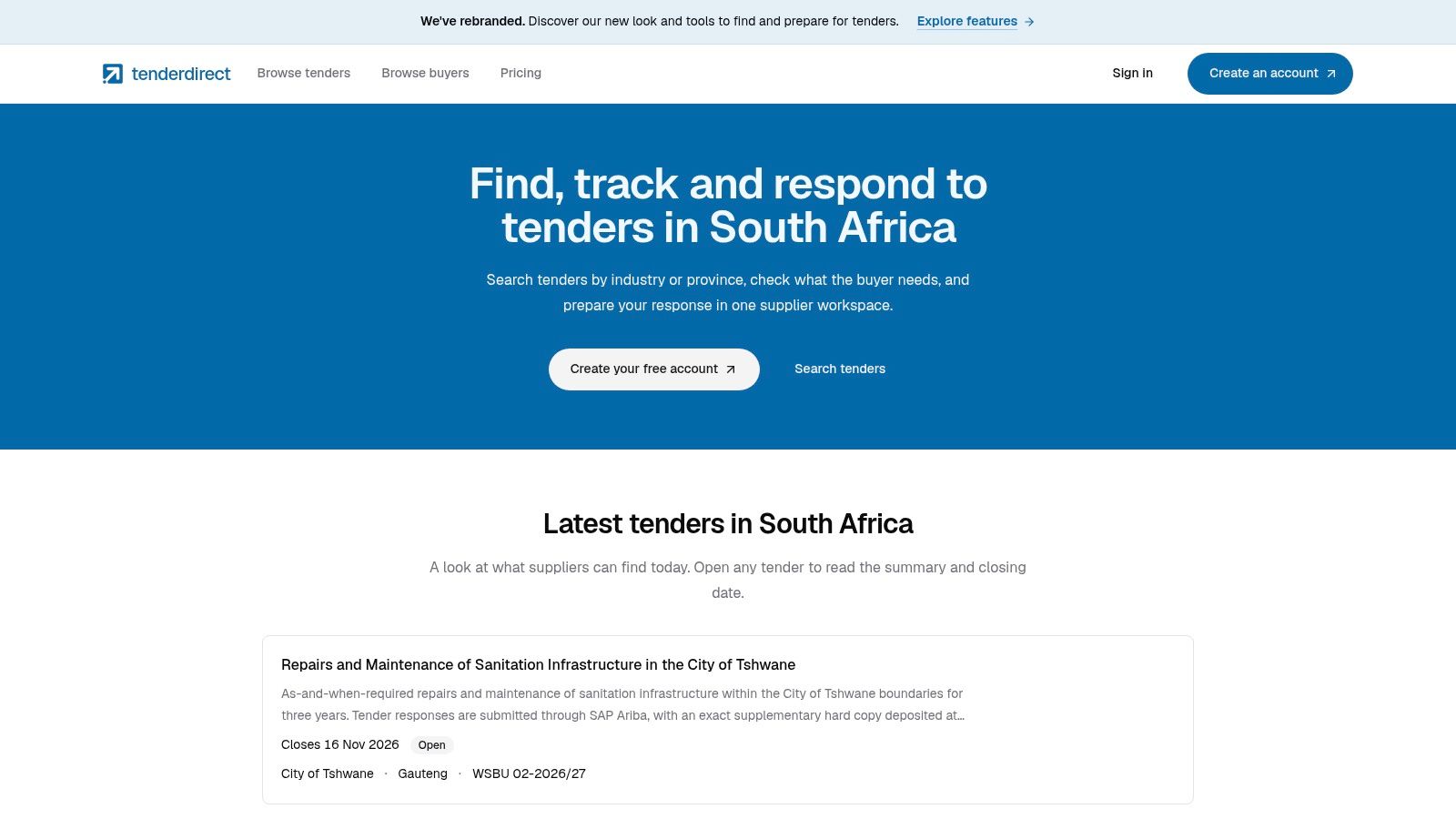
Search by capability and delivery area. Browse a catalogue of South African tenders by industry and province, then shortlist work you can deliver without relying on speculative hires or unconfirmed suppliers.
A catalogue helps you screen opportunities before downloading every pack.
Separate discovery from commitment
Check the buyer, reference, location, scope and deadline together. A familiar title doesn't make the work a fit.
Record each prospect:
| Field | What to check |
|---|---|
| Reference and buyer | The procurement process |
| Delivery location | Transport, staffing and support needs |
| Closing date and time | Time available to prepare |
| Compulsory briefing | Whether attendance is required and possible |
| Submission channel | Where and how to submit |
| Validity period | How long your offer must stand |
Mark details missing from the listing unconfirmed until you read the full pack.
Make alerts useful
Set alerts for your core services and provinces. Save plausible opportunities, assign a reviewer and record a bid decision. A saved listing is not an application.
Public previews can help you assess initial fit. If earlier document access costs money, weigh the extra preparation time against the tender's complexity before paying.
For a visual companion to your search routine, use the video below.
Download the complete pack before committing to a bid. Use the issuing documents, not the listing summary, and keep originals separate from working copies.
Deciding Whether to Bid
The lowest price doesn't automatically win. First check whether your bid can meet the requirements. Then assess how an acceptable offer would score.
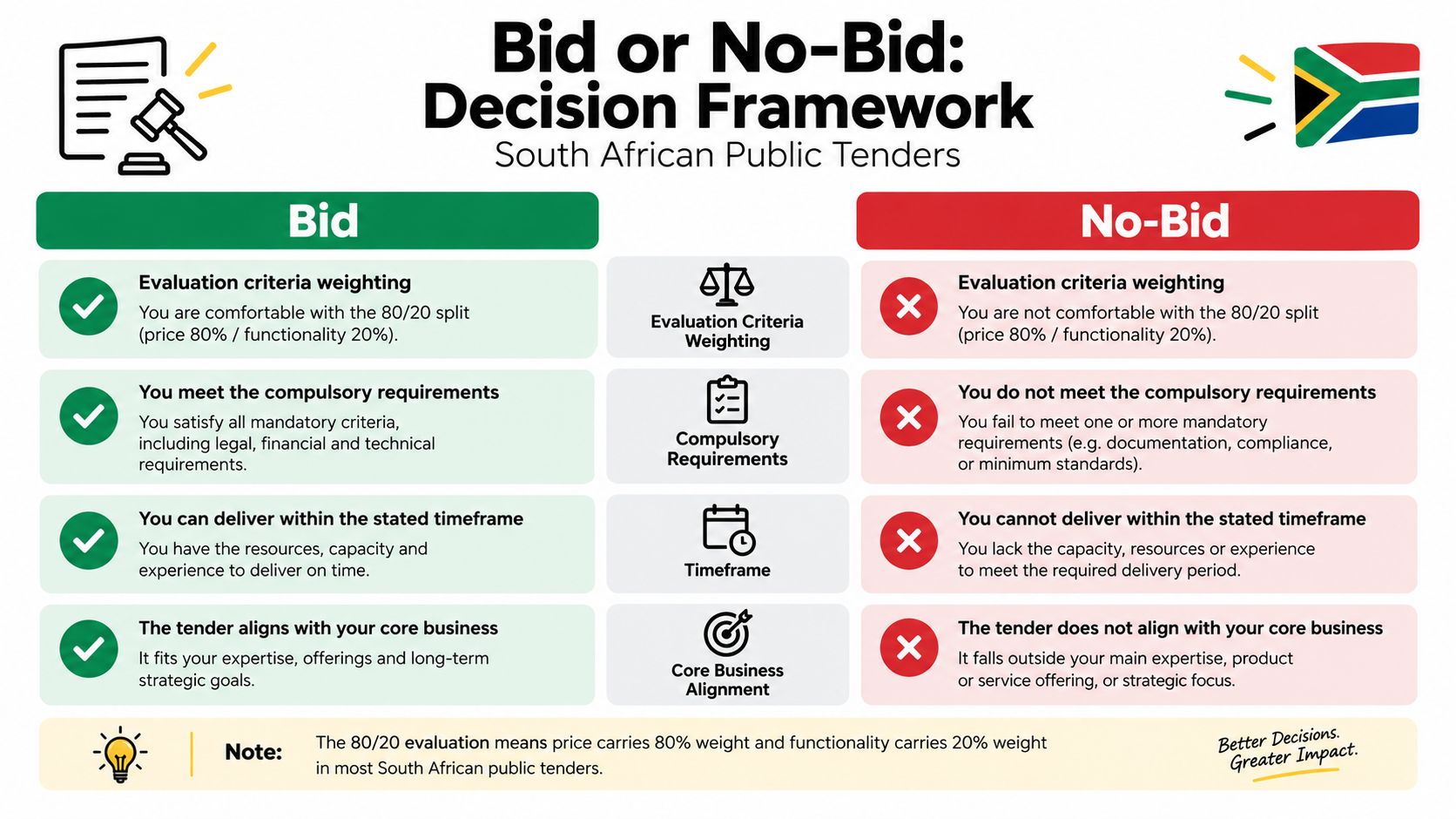
Under the Preferential Procurement Regulations, 2022, 80/20 applies where the lowest acceptable tender is R50 million or less and 90/10 applies above that threshold. Price is scored relative to the lowest acceptable tender; the remaining points cover specified goals. Award is generally to the highest-scoring tenderer, subject to the statutory framework and justified objective criteria.
Separate qualification from preference
Mandatory requirements and preference goals are different. A low price or ownership claim won't replace required project references. Nor does B-BBEE evidence automatically earn every preference point: check each goal, its allocation and the required proof.
Use the graphic to screen your decision, but note this correction: the preference split covers price and specified goals, not price and functionality. Functionality is assessed under the tender's separate provisions.
Test the commercial case before writing
You won't know competitors' prices before closing. Test plausible scenarios using the prescribed formula, then assess the preference points you can prove.
Compare buyer requirements and procurement opportunities with your resources, but let the tender pack decide:
- Mandatory fit: Can you prove every condition, including experience and financial requirements?
- Capacity: Are people, equipment, stock and partners available?
- Preference evidence: Can you substantiate each goal you claim?
- Price: Have you covered delivery, VAT treatment, warranties, subcontracting, escalation and working capital?
Don't bid if you cannot close a mandatory gap before the deadline or deliver profitably. Ask the buyer for clarification through the stated process when wording is unclear.
Preparing a Compliant Bid Response
Treat the response as a controlled set of instructions, evidence, declarations and prices, not just a proposal. The Auditor-General reported R45.5 billion in irregular expenditure, largely linked to procurement and contract-management rules not being followed, in its citizens' report on audit outcomes. This is not a bidder-disqualification figure, but it underscores the importance of compliance controls.
Build a requirement-to-evidence map
From the complete pack, list every returnable and record the reference, briefing, deadline, submission channel, validity period, pricing schedule and mandatory specifications.
| Requirement | Evidence or response | Owner | Review status |
|---|---|---|---|
| Supplier information | Current profile and declarations | Administrator | Matched to entity records |
| Technical specification | Clause-by-clause response and evidence | Technical lead | Checked against specifications |
| Preference claim | Proof requested for each stated goal | Bid owner | Matched to claim |
| Pricing | Completed buyer schedule | Finance lead | Independently recalculated |
The standard bidding forms and supplier-information requirements show why CSD details, tax status, ownership and preference evidence must agree. Check eligibility and preference evidence separately; they serve different purposes.
Use this checklist with your tender-specific matrix, not instead of it.
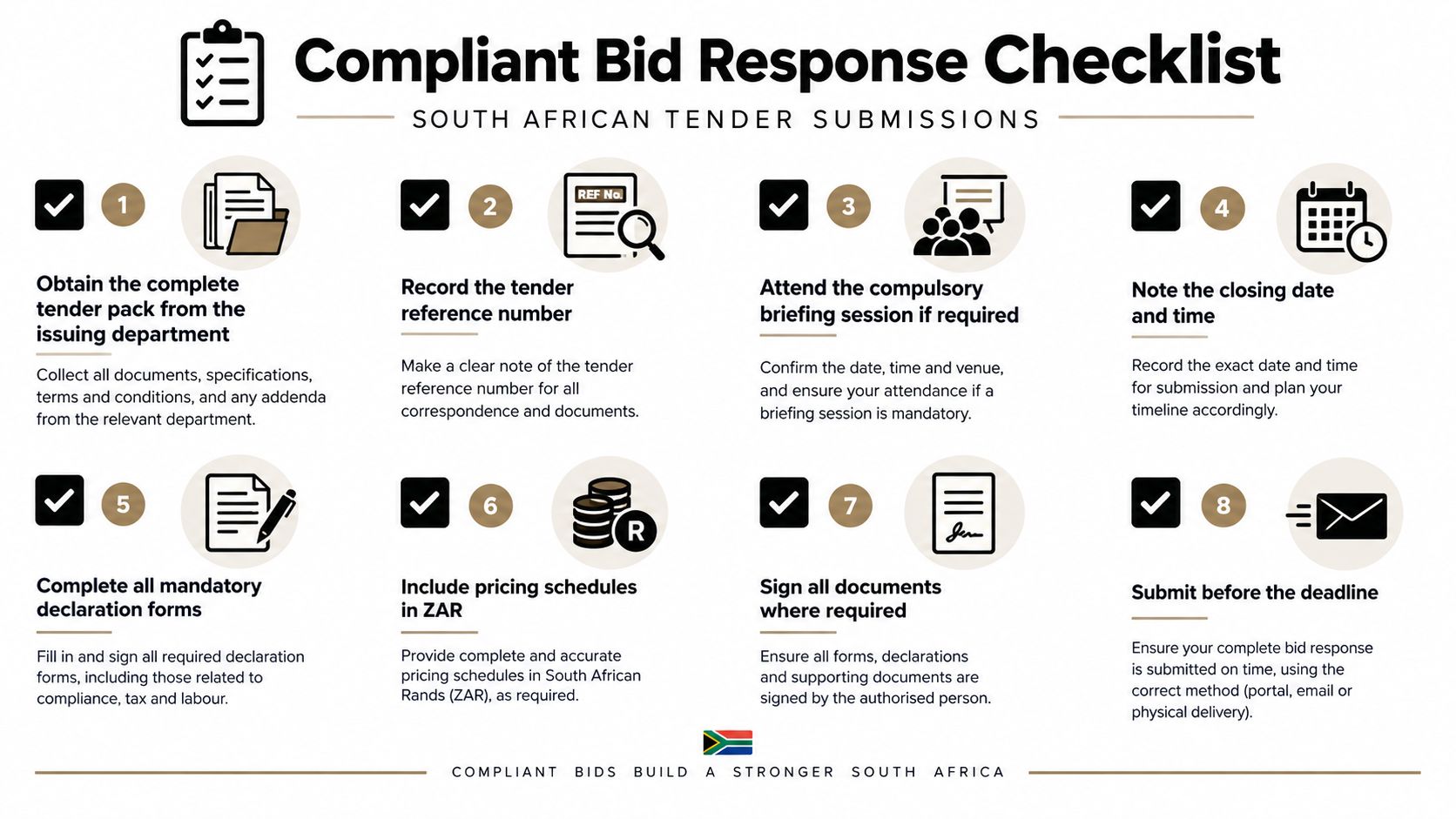
Freeze, review and submit
Complete the SBD or MBD forms in the issued pack. Don't reuse old answers without checking the current wording and evidence rules. Set an internal freeze so a reviewer can inspect the complete response against the buyer's instructions.
- Documents: Check signatures, initials, dates, certificates, tax details and page numbering.
- Pricing: Recalculate quantities, rates and totals; reconcile the buyer's schedule with your cost model.
- Packaging: Check filenames, formats, file limits, copies and physical packaging where required.
- Evidence: Make every claim traceable to a legible, relevant document.
Submit through the prescribed channel before closing. A supplier workspace helps organise the bid but does not replace the buyer's instructions. Save the final version with its email headers, portal confirmation or delivery receipt.
Bidding When You Lack Track Record or Audited Accounts
Suppose a maintenance supplier has capable technicians but no audited accounts or government contracts. A larger partner may help only if the tender permits the arrangement and accepts that partner's evidence.
These barriers are documented. In the National Business Initiative's 2025 report on ethical public procurement, 52% of respondents disagreed that public procurement was fair and accessible. Focus groups also cited complex documentation, financial-stability evidence and prior-project requirements as barriers for startups.
Match the gap to permitted evidence
Read each requirement literally. Must audited accounts belong to the bidder, or is another form of financial proof allowed? Can key personnel or a permitted joint venture supply experience, or must the bidding entity have it?
| Requirement | Evidence to investigate | Limitation |
|---|---|---|
| Delivery experience | Private-sector project records | Must meet the tender's definition |
| Technical competence | Personnel CVs and qualifications | May not replace entity-level experience |
| Financial capacity | Financial records or bank evidence | Must be accepted by the tender |
| Specialist capability | Documented partner resources | Structure must be permitted |
These are options to check, not automatic substitutes. A bank statement may not replace audited accounts; a technician's CV may not replace company references.
Document the partnership properly
If subcontracting or a joint venture is allowed, document roles, work shares, resources, signatures and required consent. Confirm whose credentials count and what must be disclosed.
A partner's credentials help only if the tender lets you rely on them and the partner has committed to the work. Don't claim an informal discussion as a secured partnership or present another firm's projects as your own.
The supplier may pursue a compliant joint bid, take a permitted subcontracting role or build experience before bidding again.
Troubleshooting Common Submission Problems
Check problems against the issued instructions. Before closing, you may be able to correct and resubmit. After closing, only the bid document's rules determine what, if anything, the buyer may accept.
Identify the symptom and act
| Symptom | Likely gap | Immediate action |
|---|---|---|
| Wrong submission channel | Instructions not captured | Repackage for the prescribed route before closing |
| Missing mandatory form | Returnables not mapped | Complete the issued form and obtain signatures |
| Conflicting company, bank or tax details | Records not reconciled with CSD fields | Investigate and verify the correction |
| Failed upload or unreadable files | Limits or formats not tested | Check limits and reopen final files |
| Review runs into closing time | No preparation buffer | Respect the deadline; submit only a compliant bid |
Save the acknowledgement for the prescribed channel. A screenshot of an upload attempt alone does not confirm submission.
Learn from the evaluation outcome
If unsuccessful, request feedback through the buyer's process. Ask whether responsiveness, functionality, preference points or price affected the result.
- Record the specific weakness.
- Assign an owner to fix reusable evidence or process gaps.
- Apply the lesson to the next bid/no-bid decision.
If feedback isn't available, improve your controls without guessing why the bid lost.
Building a 90-Day Tender Readiness Cycle
A 90-day readiness cycle is an internal routine, not a statutory deadline. Use it to keep documents, opportunity decisions and evaluation lessons current. A tender search and response workspace, shared calendar and controlled compliance folder can help; assign an owner to each.
Keep the routine manageable
- Weekly: Triage alerts and assign the next action for each live bid.
- Monthly: Check compliance records, expiries and changes to ownership, banking or contacts.
- After each outcome: Record feedback and update the relevant evidence or bid/no-bid rule.
At the end of each cycle, check whether the bids justified the effort and which capability gaps keep recurring. The goal is a current, consistent, tender-specific response without rebuilding your paperwork under deadline pressure.
TenderDirect offers a searchable tender catalogue, alerts and a supplier workspace. Visit TenderDirect to find work in your delivery area, then check the tender against your compliance pack before bidding.